
The Haschur Process for Greater Sustainability, Increased Efficiency and Improved Product Quality in Tissue Production
Press | 22. November 2024
As a long-standing expert in the tissue industry, SAUERESSIG continuously develops innovative technologies that address current sustainability challenges and significantly increase process efficiency in tissue production. This also applies to the SAUERESSIG “Haschur” process, which can be used for new designs and offers a wide range of advantages when modifying and reconditioning existing rollers.
The principle is simple yet ingenious. Whereas embossing roller designs previously featured closed shapes with continuous lines, the Haschur process replaces these with shorter elements, such as short lines or dots. This significantly reduces the pressing area and, as a result, lowers the amount of adhesive required.
These savings not only reduce material consumption, but also improve the properties of the finished tissue product – particularly its softness. At the same time, the process has no negative impact on ply bonding quality: in numerous test runs, the individual plies did not separate in a single case.
Comparisons between existing designs and designs reworked using the Haschur process show that the pressing area can be reduced by up to 50%.
The process is also particularly noteworthy for the potential productivity gains achieved by operating the production line at higher speeds.
According to customer feedback, production speed can be increased by up to 20% while maintaining consistently strong ply bonding.
The Haschur process developed by SAUERESSIG therefore addresses key issues relating to efficiency and sustainability while meeting – and in most cases even exceeding – the exceptionally high quality requirements placed on the end product. In tissue production, this results in significant resource savings, both in terms of adhesive consumption and overall energy use, which can be reduced through more efficient machine performance.
More sustainable production requires a resource-efficient tool. The Haschur process gives manufacturers the opportunity to review established designs and proven patterns from the tissue segment and modify them so that they benefit from the advantages described above. Even embossing rollers that are already in use can be reconditioned according to this principle – a fast, cost-effective and sustainable approach that reduces material consumption many times over compared with the production of a new steel core. Following coating and surface processing using the laser-etching process, the result is a high-performance tool.
SAUERESSIG combines all established engraving processes under one roof, including advanced laser-etching processes, molletage and state-of-the-art direct structuring technologies. These diverse embossing techniques enable SAUERESSIG to offer an ideal combination of creative designs and optimised product properties, the individual arrangement and implementation of embossing points, the combination of different flank angles, as well as seamless, continuous engraving across the entire circumference of the embossing roller. The creative implementation of the surface designs is carried out by experienced designers and experts, taking all relevant technical details into account.
At SAUERESSIG, innovations and developments in the field of high-quality embossing tools are accompanied by continuous advances in mechanical engineering. SAUERESSIG tissue embossing calenders make it possible to finish a wide variety of tissue materials and create outstanding visual, tactile and functional surface effects. They are available in different configurations depending on the specific requirements of the customer.
With the new TPE 900 embossing unit, the proven concept is now being taken to the next level.
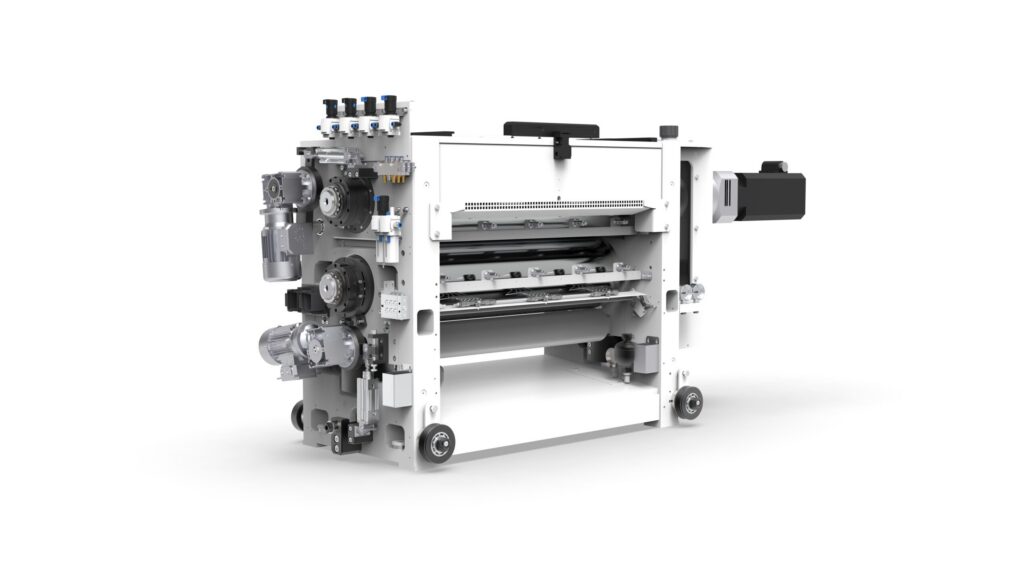
The TPE 900 embossing unit is a versatile and flexible calender with a roller width of 900 mm and four lanes for embossing and finishing tissue products. Embossing can be carried out using point-to-flat, point-to-point and nested embossing configurations, creating strong ply bonding. With an adjustable, backlash-free triple-bearing system and integrated deflection compensation to reduce vibrations, the embossing unit enables stable, reliable and efficient production.
Through continuous investment in the development of resource-efficient production tools such as the “Haschur” process and precise machine engineering designed for maximum efficiency, SAUERESSIG is continually expanding its portfolio and providing the essential support required to meet the individual demands placed on the finished tissue product. Increased efficiency and important steps towards achieving defined sustainability targets therefore go hand in hand.
This article was published in the November 2024 issue of TissueMAG.
Learn more about our comprehensive solutions for the tissue industry and the converting sector.
